
Tea, one of the world’s most beloved beverages, boasts a rich diversity that stems from variations in cultivation, processing, and regional traditions. To truly appreciate tea, it helps to understand how it is classified. Here, we explore the main methods used to categorize tea.
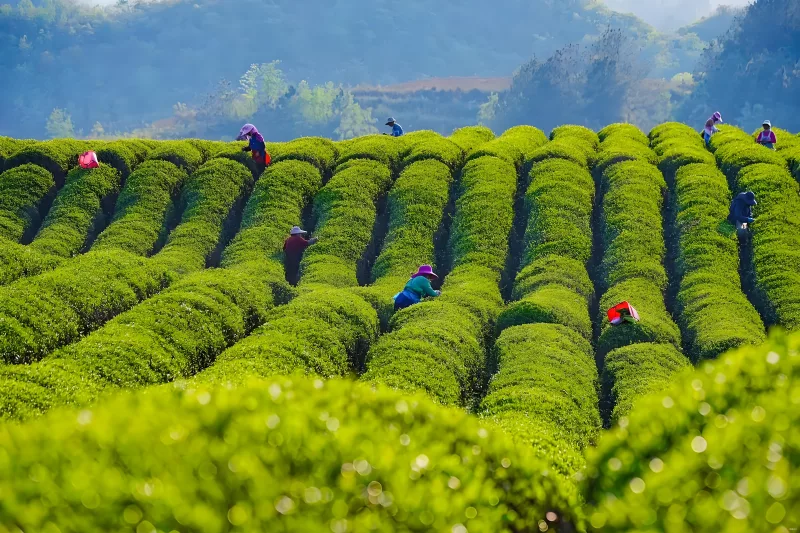
1. Classification by Tea Plant Variety
Tea plants can be grouped based on their botanical characteristics:
- By Reproduction Method:Sexual varieties (grown from seeds) and asexual varieties (propagated through cuttings or cloning).
- By Leaf Size:Extra-large, large, medium, and small-leaf varieties.
2. Classification by Place of Origin
Many famous teas are named after their growing regions, which often reflect unique terroir-driven flavors. Examples include:
- West Lake Longjing (Xi Hu Long Jing)
- Dongting Biluochun
- Anxi Tieguanyin
- Dong Ding Oolong
- Huangshan Maofeng
- Mengding Ganlu
- Wuyi Rock Tea (Yan Cha)
- Yunnan Pu’er Tea
3. Classification by Dry Leaf Shape
Tea leaves are often processed into distinctive shapes, such as:
- Flat and Slender:Liuan Guapian
- Spiral-shaped:Dongting Biluochun
- Needle-shaped:Junshan Yinzhen
- Curved and Tightly Rolled:Zhen Mei
- Compressed:Brick Tea
4. Classification by Leaf Form
This refers to the physical state of the finished tea:
- Loose Tea (Sǎn Chá):Individual, separate leaves—common for green, black, and oolong teas.
- Compressed Tea (Tuán Chá):Pressed into shapes like cakes, bricks, or tuo cha. This includes historical forms like Dragon Phoenix Cake and modern Pu’er cakes.
5. Classification by Roasting Temperature
Roasting level influences flavor and aroma:
- Light Roast (Shēng Chá):Lightly baked to preserve fresh, floral notes.
- Medium Roast (Bàn Shú Chá):Offers a richer, more pronounced aroma.
- Heavy Roast (Shú Chá):Deep roasting creates bold, ripe-fruit or toasty notes.
6. Classification by Fermentation Level
A key factor defining tea types:
- Non-fermented Tea (e.g., Green Tea):Longjing, Biluochun, Xinyang Maojian.
- Semi-fermented Tea (e.g., Oolong):15%–70% oxidation; includes Tieguanyin, Da Hong Pao, and Dong Ding Oolong.
- Fully Fermented Tea (e.g., Black Tea):100% oxidized, such as classic red teas.
7. Classification by Harvest Season
The timing of the harvest significantly affects tea quality:
- Spring Tea:Picked between Jingzhe, Chunfen, Qingming, and Guyu (early spring). Prized for tenderness and complexity.
- Summer Tea:Harvested between Lixia, Xiaoman, Mangzhong, Xiazhi, Xiaoshu, and Dashu (summer months). Often stronger and more astringent.
- Autumn Tea:Gathered between Liqiu, Chushu, Bailu, and Qiufen (early to mid-autumn). Aromatic but lighter than spring tea.
- Winter Tea:Harvested after Hanlu, Shuangjiang, Lidong, and Xiaoxue (late autumn to early winter). Rare and mild in flavor.
From plant type and processing to harvest time, each classification method offers a window into the incredible diversity of tea. Understanding these categories can enhance your appreciation and guide your exploration of different tea styles. Whether you’re a casual drinker or a dedicated connoisseur, knowing how tea is classified adds depth to every cup.
Edit by Yilinature / 2025.11.11